
Buyer’s guide

Best Mini Split AC and Heat: Top Picks by Room, Climate and Install

Choose an inverter heat pump sized to your room, with a warranty that fits how it will be installed. ENERGY STAR’s chart lists 12,000 BTU at 450–550 sq ft as a starting point, and smaller rooms need less. Our best overall pick is the MRCOOL DIY 5th Gen 12K; if you are hiring an installer anyway, Senville and DELLA cost less to buy.

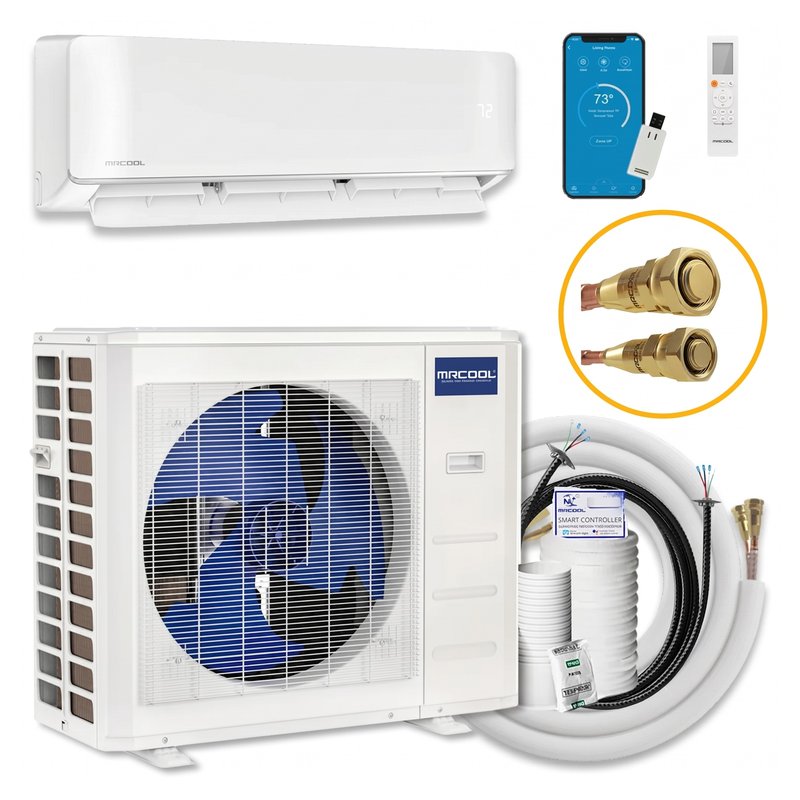
MRCOOL DIY 5th Gen 12K mini split
Our #1 pick

MRCOOL DIY 5th Gen 12K

Premium price range

Capacity12,000 BTU
Heat rated to−13°F
Install25 ft pre-charged quick-connect kit

See ratings & reviews ↗ · All 7 picks

Top picks at a glance

The best mini split AC and heat systems, by what you need

Seven systems that cover how most people use a mini split. Each one is chosen for a reason, and each card says who should skip it.

Best overall#1
MRCOOL DIY 5th Gen 12K mini split

MRCOOL DIY 5th Gen 12K

Premium price range

A 25 ft pre-charged line kit, a −13°F brand rating and a warranty MRCOOL says does not depend on a licensed contractor: the simplest fit for buying online.

Check sizes ›
Best for the money#2
DELLA Serena 12K (230V) mini split

DELLA Serena 12K (230V)

Budget price range

A Budget-tier 12,000 BTU system with 22 SEER2 and built-in Wi-Fi, for mild winters and a professional install.

Check sizes ›
Best for cold climates#3
Senville AURA 12K mini split

Senville AURA 12K

Mid-range price range

Rated by Senville to run down to −22°F, with a 10-year compressor term, at a Mid-range price.

Check sizes ›
Best large room#4
Senville LETO 24K mini split

Senville LETO 24K

Mid-range price range

One 24,000 BTU wall unit for an open-plan space, in mild-winter climates, at a Mid-range price.

Check sizes ›
Best for two rooms#5
Senville SENA 18K Dual Zone mini split

Senville SENA 18K Dual Zone

Premium price range

Two 9,000 BTU heads on one outdoor unit, with a −22°F rating and independent room control.

Check sizes ›
Best quiet bedroom pick#6
Senville LETO 12K (115V) mini split

Senville LETO 12K (115V)

Budget price range

A 115V system with a brand-rated 17.5 dB bottom fan setting, for buyers who already have an installer.

Check sizes ›
Best for a garage#7
MRCOOL DIY 5th Gen 18K mini split

MRCOOL DIY 5th Gen 18K

Premium price range

An 18,000 BTU quick-connect system with 25 ft of line, for an insulated garage or shop with 230V power.

Check sizes ›

Prices change often, so we show a price range instead of a number. Budget is under $900, Mid-range $900–$1,500, Premium over $1,500, based on typical list prices.

Find your match

Start from your situation, not the brand

Room, climate, power and install plan decide most of this. Pick the line that sounds most like you.

MRCOOL DIY 5th Gen 12K mini split

I want to install it myself

Start with

MRCOOL DIY 5th Gen 12K

Only some kits use pre-charged quick-connect lines, and warranty terms differ sharply by brand. Read what EPA says first.

Senville AURA 12K mini split

My winters get seriously cold

Start with

Senville AURA 12K

A rating to run at −22°F is not a promise of full heat at −22°F. Compare published capacity where a brand gives one.

MRCOOL DIY 5th Gen 18K mini split

It is for a garage or workshop

Start with

MRCOOL DIY 5th Gen 18K

Sellers advise insulating first, because uninsulated walls and doors raise the size you need. Start with the door and walls.

Senville SENA 18K Dual Zone mini split

I need to cover several rooms

Start with

Senville SENA 18K Dual Zone

One outdoor unit can feed several heads, but separate single-zone systems can make more sense. Get a load per room.

Senville LETO 12K (115V) mini split

I only have 110-volt power nearby

Start with

Senville LETO 12K (115V)

A 115V mini split still needs its own dedicated circuit. It does not plug into a wall outlet, and the lines we checked mostly top out at 12,000 BTU.

Senville LETO 9K (230V) mini split

It has to be quiet enough to sleep

Start with

Senville LETO 9K (230V)

Low-fan ratings run from about 17.5 to 30 dB here, but brands state them differently. Size matters as much as the number.

Our picks in detail

What each system does well, and who should skip it

Specifications and ratings come from each brand; fit notes draw on ENERGY STAR, DOE and manufacturer documents. We have not tested or used these systems. How we pick.

Best overall#1

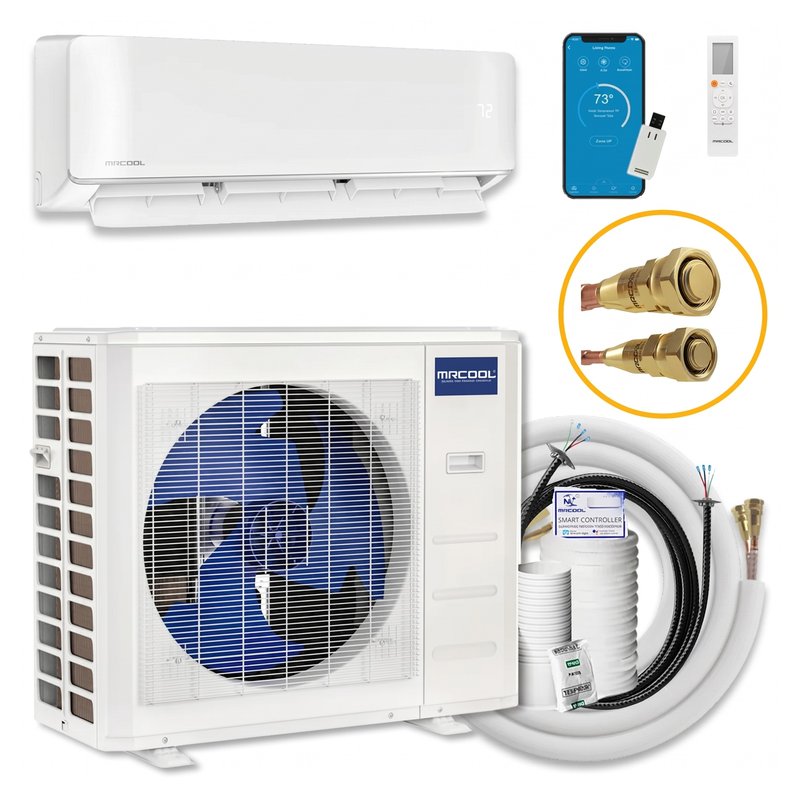
MRCOOL DIY 5th Gen 12K

This is the sensible first system to look at if you are buying online. The kit ships with a 25 ft pre-charged quick-connect line set, the brand rates heating down to −13°F, and MRCOOL states its DIY warranty does not depend on a licensed contractor. You can still hire one, and many buyers should.

Why it stands out

  • Brand-rated 23.5 SEER2 and heat operation to −13°F on a 115V circuit.
  • Longest included line set in the MRCOOL DIY family: 25 ft, pre-charged, with a brand-stated no-vacuum connection.
  • 5-year parts and 7-year compressor warranty per MRCOOL, with no registration required; labor is not covered.
Capacity12,000 BTU
SEER223.5
Power115V
Heat rated to−13°F
Install25 ft pre-charged quick-connect kit

Good fit if

  • One room up to about 550 sq ft (the brand’s figure).
  • You want a warranty that does not rest on a licensed install.
  • You can put in a dedicated 115V, 20A circuit.

Skip it if

  • Price matters most: a professionally installed LETO or Serena costs less to buy.
  • You have no dedicated circuit and no electrician lined up. It does not plug into a wall outlet.

EPA’s published Q&A says connecting pre-charged lines on an R-410A mini split requires Section 608 certification. Some sellers say otherwise for quick-connect kits. This system uses R-454B and we found no EPA statement on such kits, but EPA’s Section 608 page says the rules cover substitutes such as HFCs, so do not assume the R-410A answer leaves it out. Check with EPA and your local code office before you self-install.

Best for the money#2

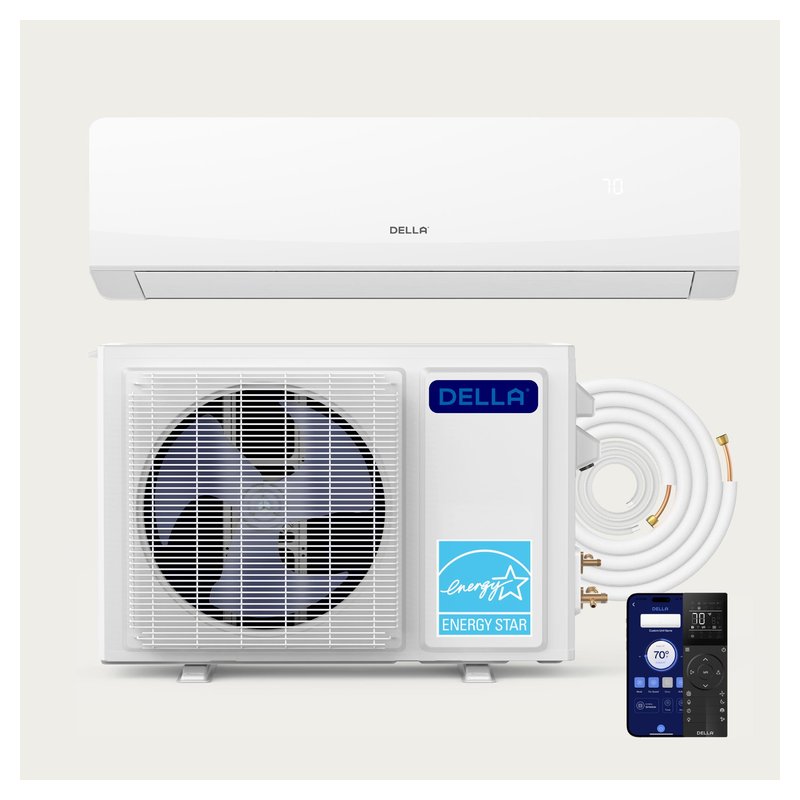
DELLA Serena 12K (230V)

The Budget pick for a mild climate. You get built-in Wi-Fi and a high SEER2 for the tier, and DELLA offers lifetime parts coverage if you register within 100 days. The trade-off is heating range and an unpublished indoor noise figure.

Why it stands out

  • Brand-rated 22 SEER2 and 9.5 HSPF2 (Region IV) on 208–230V.
  • Built-in Wi-Fi with the DELLA app, Alexa and Google Home.
  • Lifetime parts coverage if registered within 100 days, per DELLA; labor is on you.
Capacity12,000 BTU
SEER222
Power208–230V
Heat rated to5°F
Install16 ft copper line set; use an HVAC pro

Good fit if

  • A room up to about 550 sq ft on a tight budget.
  • Winters stay above 5°F.
  • You have an HVAC pro lined up.

Skip it if

  • You heat below 5°F.
  • You want a stated indoor noise figure before you buy.
Best for cold climates#3

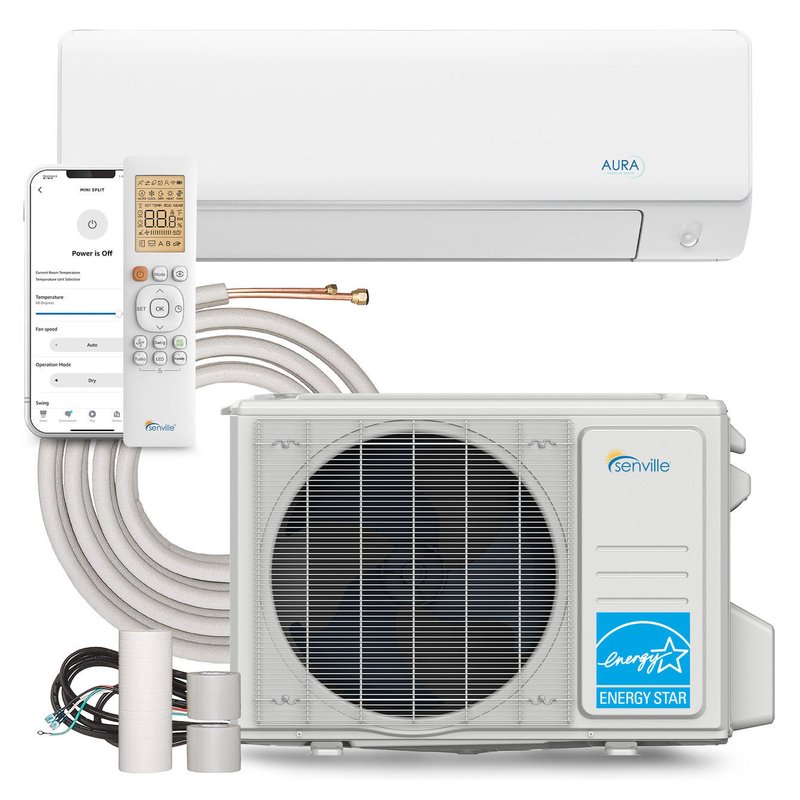
Senville AURA 12K

The cold-climate pick for one room. Senville rates AURA to operate down to −22°F with a 10-year compressor term. The brand does not publish heating capacity at −13°F or −22°F on this page, so a rating to run at a temperature is not a promise of full heat at that temperature.

Why it stands out

  • Brand-rated heat operation to −22°F; heating range 4,000 to 14,500 BTU per Senville.
  • Brand-rated 25.4 SEER2 on a 208/230V circuit.
  • 5-year parts and 10-year compressor warranty, subject to Senville’s install terms.
Capacity12,000 BTU
SEER225.4
Power208/230V
Heat rated to−22°F
InstallLicensed pro required by the brand

Good fit if

  • One room where you want a −22°F rating, with a professional install.
  • You want a Mid-range price and a long compressor term.

Skip it if

  • You need a published capacity figure for a heat-loss calculation: look at Gree Sapphire.
  • You want to self-install: Senville says DIY installation voids the warranty.
Best large room#4

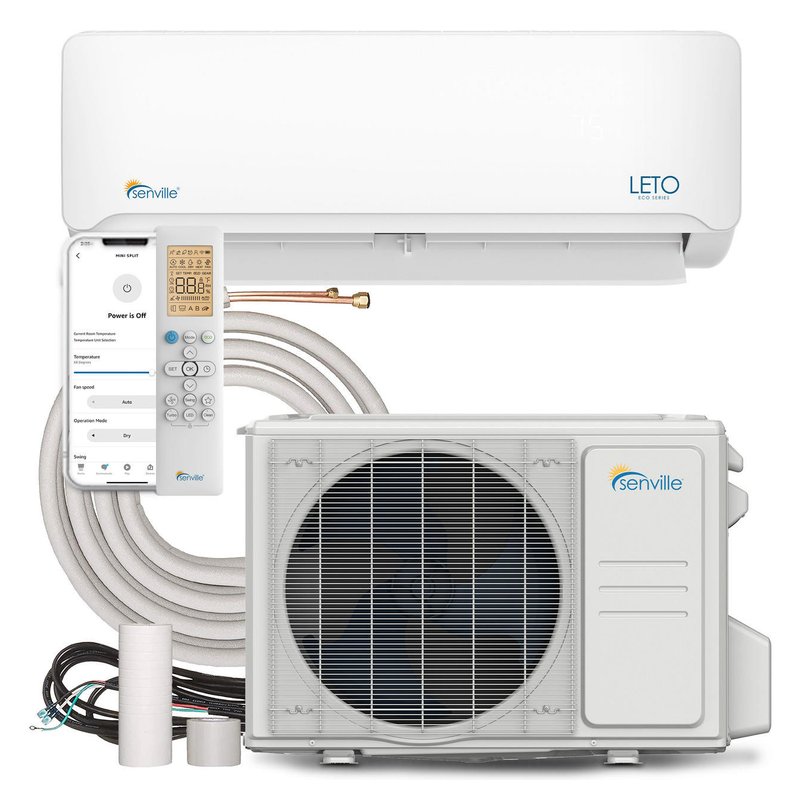
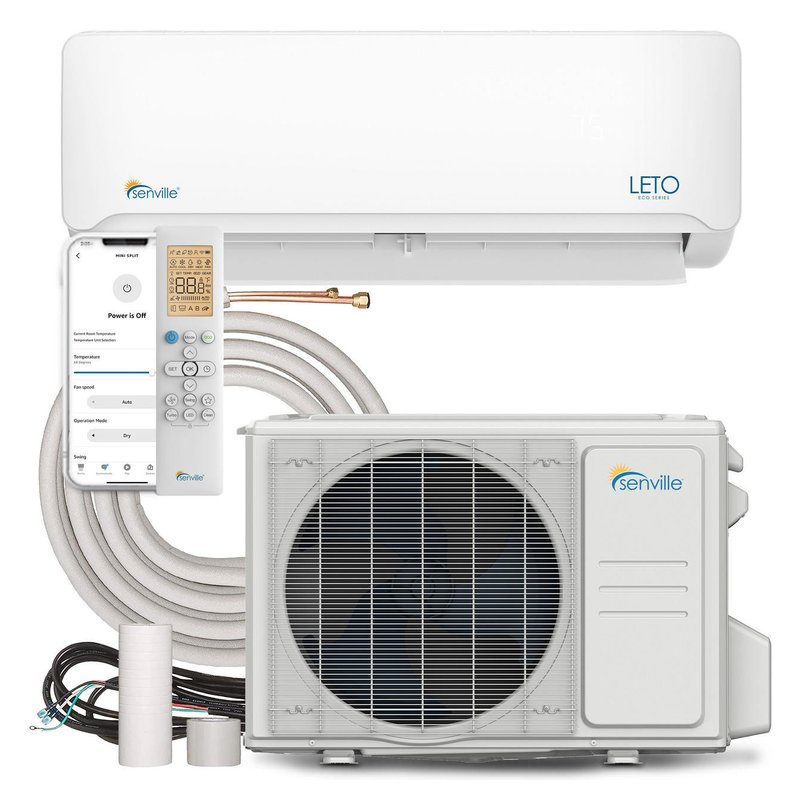
Senville LETO 24K

One wall unit for a large open space at a Mid-range price. Its rating favors mild winters, and at top speed it is loud enough that it belongs in a living area rather than a bedroom.

Why it stands out

  • 24,000 BTU cooling and heating per Senville.
  • Brand-rated 18.7 SEER2 and up to 164 ft of line in the brand’s table.
  • 5-year parts and 5-year compressor warranty, subject to Senville’s install terms.
Capacity24,000 BTU
SEER218.7
Power208/230V
Heat rated to5°F
InstallLicensed pro required by the brand

Good fit if

  • An open-plan space or great room with a 230V circuit.
  • Mild winters and a professional install.

Skip it if

  • You need heat below 5°F: look at AURA.
  • It is for a bedroom: the brand rates top fan speed at 54 dB indoors.
Best for two rooms#5

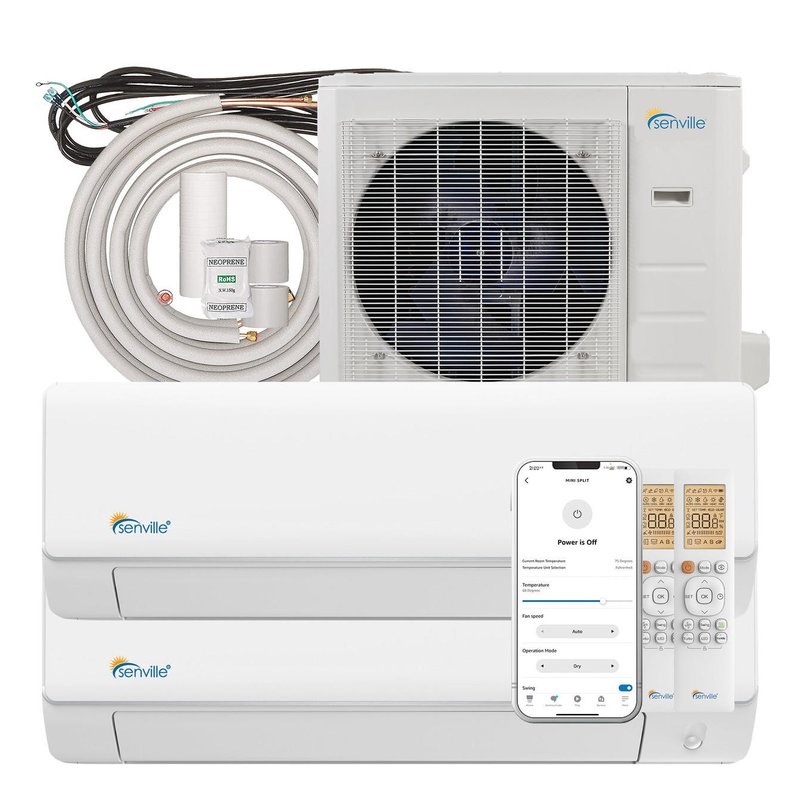
Senville SENA 18K Dual Zone

A two-room system from one outdoor unit, with two 9,000 BTU indoor heads. It suits two small bedrooms that need separate control. Field work has found multi-zone systems can be less efficient, so get a load per room before you commit.

Why it stands out

  • Two 16 ft kits included; pre-charged for 75 ft combined per Senville.
  • Brand-rated 25 SEER2 and heat operation to −22°F.
  • 5-year parts and 10-year compressor warranty, subject to Senville’s install terms.
Capacity18,000 BTU, 2 zones
SEER225
Power208/230V
Heat rated to−22°F
InstallLicensed pro required by the brand

Good fit if

  • Two small rooms that fit one outdoor location.
  • A licensed installer is already part of the plan.

Skip it if

  • One room needs more than 9,000 BTU.
  • The combined line run passes 75 ft, which means adding refrigerant on site.
Best quiet bedroom pick#6

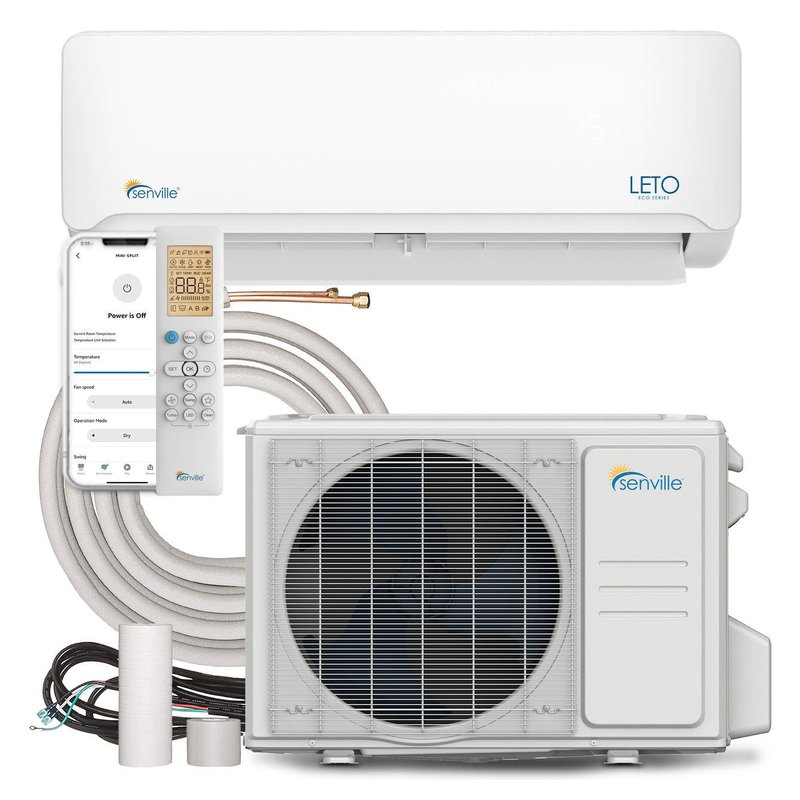
Senville LETO 12K (115V)

A Budget-tier 115V system for buyers who are hiring an installer anyway. Senville’s very low bottom fan setting makes it a natural bedroom candidate, as long as winters stay above its 5°F rating.

Why it stands out

  • Brand-rated 21.2 SEER2 on a 115V circuit.
  • Brand-rated 17.5 dB indoors at the lowest fan setting and 25 dB on low.
  • 5-year parts and 5-year compressor warranty, subject to Senville’s install terms.
Capacity12,000 BTU
SEER221.2
Power115V
Heat rated to5°F
InstallLicensed pro required by the brand

Good fit if

  • A bedroom or home office up to about 550 sq ft.
  • You already have an installer lined up.
  • Winters rarely get near 5°F.

Skip it if

  • You plan to install it yourself: Senville says DIY installation voids the warranty.
  • Winters regularly go below 5°F.

This listing has been around for years. Senville’s current page shows R-454B; confirm the refrigerant and included kit on the product page.

Best for a garage#7

MRCOOL DIY 5th Gen 18K

The same quick-connect approach at 18,000 BTU suits a two-car garage, a workshop or a large open room. MRCOOL lists coverage up to 800 sq ft under ideal conditions, which is exactly why an uninsulated garage needs a load check first.

Why it stands out

  • Brand-rated 22.5 SEER2 and heat operation to −13°F.
  • 25 ft pre-charged line set gives more placement room than the shorter kits.
  • 5-year parts and 7-year compressor warranty per MRCOOL; non-transferable.
Capacity18,000 BTU
SEER222.5
Power208/230V
Heat rated to−13°F
Install25 ft pre-charged quick-connect kit

Good fit if

  • An insulated garage, shop or large room with a 230V circuit available.
  • MRCOOL states no vacuum is required; read the EPA note below.

Skip it if

  • Your garage only has 115V: the 12K is the 115V model.
  • The space is uninsulated and you have not checked the heat load.

MRCOOL’s catalog lists the 18K as 208/230V only. Confirm the voltage on the product page before you buy, and match it to your circuit. EPA’s published Q&A says connecting pre-charged lines on an R-410A mini split requires Section 608 certification. Some sellers say otherwise for quick-connect kits. This system uses R-454B and we found no EPA statement on such kits, but EPA’s Section 608 page says the rules cover substitutes such as HFCs, so do not assume the R-410A answer leaves it out. Check with EPA and your local code office before you self-install.

Side by side

Compare the specs

Scroll sideways on a phone. Ratings are each brand’s own, and heat ratings describe operation rather than full output.

Mini SplitBest forCapacitySEER2PowerHeat rated toInstallPrice range
MRCOOL DIY 5th Gen 12KBest overall12,000 BTU23.5115V−13°F25 ft pre-charged quick-connect kitPremiumDetails ›
DELLA Serena 12K (230V)Best for the money12,000 BTU22208–230V5°F16 ft copper line set; use an HVAC proBudgetDetails ›
Senville AURA 12KBest for cold climates12,000 BTU25.4208/230V−22°FLicensed pro required by the brandMid-rangeDetails ›
Senville LETO 24KBest large room24,000 BTU18.7208/230V5°FLicensed pro required by the brandMid-rangeDetails ›
Senville SENA 18K Dual ZoneBest for two rooms18,000 BTU, 2 zones25208/230V−22°FLicensed pro required by the brandPremiumDetails ›
Senville LETO 12K (115V)Best quiet bedroom pick12,000 BTU21.2115V5°FLicensed pro required by the brandBudgetDetails ›
MRCOOL DIY 5th Gen 18KBest for a garage18,000 BTU22.5208/230V−13°F25 ft pre-charged quick-connect kitPremiumDetails ›

Want to see more than our seven picks?

Browse more mini splits ›

Not sure where to start?

For one room up to about 550 sq ft, a 12,000 BTU system is the usual starting point on ENERGY STAR’s chart. The MRCOOL DIY 12K ships with its line set, and its product page lists the voltage, kit and what’s in the box.

How to choose

Five things that matter more than the brand

Size, install path and climate rating are the three decisions that shape everything else.

01

Size it to the room, then check it

ENERGY STAR’s room chart lists 12,000 BTU at 450–550 sq ft and 18,000 BTU at 700–1,000 sq ft. It also says a contractor should verify size with a Manual J load calculation, because oversizing causes short cycling and poor humidity control.

02

Read the install terms before the specs

Mitsubishi and Fujitsu tie coverage to licensed contractors, Senville says DIY installation voids its warranty, and MRCOOL’s warranty says a licensed contractor is not required for its DIY series and that local laws should be checked. This single line changes what a system really costs you.

03

Match the rating to your winter

Ratings vary from 5°F to −22°F, and they describe operation, not full output. ENERGY STAR says pairing with backup heat is most efficient at very low temperatures, so look for capacity tables if heat is the main job.

04

Check the circuit you actually have

Every unit needs a dedicated circuit; none of these plug into a wall outlet. Pioneer says 115V is limited to 9,000 and 12,000 BTU single-zone wall units in its range, and says 230V is generally preferable if you can install either.

05

Plan the line and the outdoor spot

AC Direct says pre-charged lines come in fixed lengths and cannot be cut in the field without breaking the seal. ENERGY STAR says to keep the outdoor unit away from doors and windows, because it releases water when defrosting.

FAQ

Mini split AC and heat: questions answered

Straight answers to the questions people ask before buying, drawn from DOE, ENERGY STAR, EPA, IRS and manufacturer documents. This is general information, and local rules vary.

Mini split basics5

Do mini splits do both AC and heat?

Most do, but check the model. DOE says mini split heat pumps can run in reverse to provide heating, while Gree notes that mini splits are not all heat pumps and some only cool. HVACDirect, for example, lists a Mitsubishi cooling-only system. Every system in this guide is a heat pump by its brand’s spec.

How does a mini split heat a room?

It moves heat rather than making it. ENERGY STAR explains that the outdoor unit pulls heat from outside air, even in cold weather, and refrigerant carries it indoors. In warm months the cycle reverses. That is why ENERGY STAR says ductless heat pumps can use up to 60% less energy than standard electric radiators.

Can a mini split heat one room and cool another at the same time?

No, not a standard residential system. Efficiency Maine says mini split heat pumps cannot heat and cool at the same time, and ACHR News explains that only heat recovery VRF equipment does this. All the heads on a multi-zone mini split run in the same mode.

Are mini splits worth it?

They tend to be worth it where ducts are missing or leaky, or where you are replacing electric resistance heat. DOE says ducts can waste more than 30% of space-conditioning energy, and ENERGY STAR says heating costs can be cut roughly in half compared with conventional electric heating. Results vary by climate, electricity rates and the system replaced.

Does a mini split dehumidify?

It lowers humidity while cooling, and most have a dry mode. Fujitsu describes dry mode as most useful on mild, damp days, and Pioneer says it does not replace a dehumidifier and should not run continuously. Brands disagree on energy use: Fujitsu says less than cooling, Pioneer says more than other modes.

Know you want one system for AC and heat? Start with our best overall pick.See the top pick
Sizing5

What size mini split do I need?

Start with ENERGY STAR’s room chart: 9,000 BTU at 350–400 sq ft, 12,000 at 450–550, 18,000 at 700–1,000 and 24,000 at 1,400–1,500. The chart was written for room air conditioners, and sellers often size more conservatively. ENERGY STAR says a contractor should verify the result with a Manual J calculation.

What size mini split for 500 square feet?

About 12,000 BTU is the usual starting point, based on ENERGY STAR’s 450–550 sq ft band. Add 10% for a very sunny room, subtract 10% for heavy shade, and add 4,000 BTU for a kitchen, per the same chart. Poor insulation or high ceilings push the number up, which is what a load calculation catches.

Is it bad to oversize a mini split?

Yes. DOE says oversized or poorly placed units cause short cycling, waste energy and reduce temperature and humidity control, and cost more to buy and run. ACCA names rules of thumb such as 500 sq ft per ton as a cause of oversizing. A DOE-sponsored field study found signs of oversizing at ductless sites.

How many BTU is a one-ton mini split?

One ton equals 12,000 BTU per hour of cooling capacity. HomeGuide’s table pairs 9,000 BTU with 0.75 ton, 18,000 with 1.5 tons, 24,000 with 2 tons and 36,000 with 3 tons. Heating capacity can differ from the cooling number, and it changes with outdoor temperature.

Should I get one multi-zone system or several single-zone systems?

It depends on the loads per room. Efficiency Vermont slides summarize a Massachusetts and Rhode Island study that found multi-zone systems less efficient, yet very small rooms can favor a small multi-zone head over an oversized single unit. We found no DOE statement that one always beats the other, so ask for a load per room.

Sized your room? Compare systems from 9,000 to 36,000 BTU.Browse mini split systems
Ratings and refrigerant5

What SEER2 rating should I look for?

ENERGY STAR’s floor for split heat pumps is 15.2 SEER2, while DOE’s national minimum is 14.3 SEER2. DOE gives ductless systems a typical range of 15.2 to 35 SEER2. Everything in this guide is brand-rated from 17.5 to 28. A higher number generally means lower cooling energy use, but installation quality matters too.

What is HSPF2 and why does it matter?

HSPF2 is the heating efficiency rating that pairs with SEER2, and a higher number means more efficient heating. DOE’s minimum for split heat pumps is 7.5 HSPF2; ENERGY STAR requires 7.8 and, for cold-climate non-ducted systems, 8.5. Check the region: brands often list Region IV and a lower Region V figure.

Can I compare SEER2 with old SEER numbers?

Not directly. DOE says SEER2, EER2 and HSPF2 are similar to the older metrics but not directly comparable, and ACHR News reports DOE published no official conversion. Treat any exact crosswalk as an approximation. You also cannot set SEER2 against a window unit’s CEER, which is a separate metric.

What is the difference between R-410A, R-32 and R-454B?

They differ mainly in global warming potential and flammability class. LG lists R-410A at 2,088 and R-32 at 675, and Filterbuy lists R-454B at 466. R-32 and R-454B are classed A2L, which AHRI describes as lower flammability and hard to ignite with slow flame spread. They are not interchangeable, so never mix them.

Can R-410A mini splits still be sold?

Yes, as eligible older inventory. EPA’s 2026 final rule lets R-410A equipment made or imported before 2025 be installed until supply runs out. New York and Washington keep stricter rules, California has its own limit, and the federal rule is being challenged in court. Existing systems may keep running and being serviced.

Want a current refrigerant and a high SEER2 rating? Start with the cold-climate pick.See full specs
Cold weather5

Do mini splits work in cold weather?

Yes, but output and efficiency fall as it gets colder. ENERGY STAR says cold-climate units are tested down to 5°F and keep operating below that. A Minnesota study of a Mitsubishi unit shows rated COP dropping from 3.48 at 47°F to 1.82 at 5°F. A retailer says standard heat pumps work down to roughly 20–25°F.

Does a −22°F rating mean full heat at −22°F?

No. It tells you the unit is rated to operate there, and capacity is a separate number. ENERGY STAR’s cold-climate criteria call for only 70% of 47°F capacity at 5°F. Among the systems here, Gree publishes 9,758 BTU at −22°F for its 12,000 BTU Sapphire. Senville does not publish a −22°F capacity for AURA.

Do I need backup heat with a mini split?

Sometimes, and the sources disagree. ENERGY STAR says pairing with backup is most efficient at very low temperatures, Fujitsu says backup is not required if its installation steps are followed, and METUS says a supplemental source may be recommended in extremely cold regions or poorly insulated homes. Ask for a load calculation at your design temperature.

How much does defrost affect a mini split?

It varies widely. A Brookhaven National Laboratory report found defrost under 4% of runtime at ductless sites, while a preliminary DOE deck on one 1-ton unit in very cold conditions reported about 60% of time in defrost or recovery. ENERGY STAR says to place the outdoor unit away from doors and windows because it releases water during defrost.

Should I turn a mini split down at night in winter?

Usually not by much. ENERGY STAR says heat pumps do not save by setback the way furnaces or boilers do, and Efficiency Vermont slides say deep setbacks cause long recovery in the least efficient mode. ENERGY STAR also advises choosing heat or cool rather than Auto, to avoid mode-switching in mild weather.

Heating through real winters? Compare published ratings and capacity first.What owners say
Cost and incentives5

How much does a mini split cost installed?

HomeGuide lists $2,500 to $6,000 for a single zone and $6,500 to $15,000 or more for multi-zone. Bob Vila lists $2,000 to $8,800 for a single zone. Consumer Reports found the 12,000 BTU models it tested cost $799 to more than $1,860 before installation. Permits add about $250 to $400, per Bob Vila.

How much can I save with a DIY mini split?

We found no source that measures it. HomeGuide lists $3,500 to $5,000 installed for 12,000 BTU, and Consumer Reports lists $799 to more than $1,860 before installation. You still need a circuit, about $250 in Angi’s older figures. EPA’s position and brand warranty terms also apply, so check both first.

How much does a mini split cost to run?

There is no single figure, because it depends on your climate, electricity rate and what you are replacing. ENERGY STAR says heating costs can be roughly halved compared with conventional electric heating. A seven-home Minnesota study reported 30–56% savings, while a larger Massachusetts and Rhode Island study found small savings.

Is there still a federal tax credit for mini splits?

No, not under 25C. The IRS says the credit will not be allowed for any property placed in service after the end of 2025. Some ENERGY STAR pages still mention a credit through 2032, but the IRS controls. Keep any paperwork for state or utility programs, which are separate.

Are there still rebates for mini splits?

In some places. The federal HEAR program is run by states, limited by income, and availability varies; trackers disagree on how many states are open, and Aurora Solar reported California’s single-family funds exhausted in early 2026. Oregon, for example, lists up to $8,000 for a heat pump. Check your state program and your utility.

Watching the budget? Our for-the-money pick sits in the Budget tier.Check size options
Installation5

Can I install a mini split myself?

Some kits are marketed for it, but read the rules first. MRCOOL’s warranty says a licensed contractor is not required for its DIY series. EPA’s Q&A says connecting pre-charged lines on an R-410A mini split requires Section 608 certification, while some sellers say quick-connect kits do not. We found no EPA statement on R-454B quick-connect kits, so ask EPA and your local code office.

Does a DIY mini split need a vacuum pump?

Quick-connect kits from MRCOOL and Klimaire are sold as no-vacuum, and EPA’s position on pre-charged lines still applies. But pre-charged does not always mean no-vacuum: DELLA’s FAQ for its pre-charged Optima says you will need to vacuum the system during installation. Read the install section of the manual for the exact model before you buy.

Can a 110-volt mini split plug into a wall outlet?

No. AC Direct says existing outlets cannot be used, and Filterbuy says every unit needs its own circuit. MRCOOL lists a 20A max fuse for its 115V 12,000 BTU system. Have a licensed electrician add the circuit and a disconnect to code. Pioneer offers 115V only on 9,000 and 12,000 BTU single-zone wall units.

Will a DIY install void the warranty?

It depends on the brand. Senville says DIY installation will void its warranty coverage, while Mitsubishi and Fujitsu require licensed contractors. MRCOOL says a contractor is not required for its DIY series, but faulty installation is excluded and labor is not covered. Read the warranty for your exact model and keep your proof of purchase.

Do I need a permit to install a mini split?

Probably. HomeGuide says most localities require a permit, and Bob Vila says a homeowner will likely need one, especially for multi-zone systems, at about $250 to $400 on average. Rules vary by city and state, so call your local building department. Electrical work usually has its own requirements.

Prefer the quick-connect route? This is the kit most of our DIY coverage centers on.Check line set & specs
Brands and care5

What is the best mini split brand?

There is no single winner, because it depends on how you buy. As summarized by SlashGear, Consumer Reports ranks Mitsubishi and Fujitsu highly, and those brands sell through contractors. CR’s heating test ran at 40°F outdoors, so it says little about deep cold. For buying online, MRCOOL has the clearest no-contractor warranty language, while Senville and DELLA compete on price with professional installation.

Should I buy Mitsubishi or Daikin online?

Be careful. Mitsubishi says internet and auction purchases get no warranty or support, even if unopened, and that coverage needs a licensed contractor. Daikin says no warranty is offered on internet purchases unless a dealer following applicable law installs them. Third-party listings exist, so confirm coverage before buying. A local dealer quote is the safer path.

Who actually makes MRCOOL, Senville and Pioneer?

We could not confirm it. Blogs and dealers variously name Midea, Gree or the brands themselves, and we found no first-party or regulatory document that settles it. Treat rebadging claims as unconfirmed, and judge the system by its warranty, published specs and support instead.

How often should I clean mini split filters?

Clean them when they look dirty or when the filter light comes on, as ENERGY STAR advises. Brands give different intervals: Trane says as often as every two weeks in peak season, Carrier says monthly, and Pioneer says every two to four weeks. Follow your manual. Trane also recommends professional maintenance at least once a year.

How long do mini splits last?

Commonly cited figures are 10 to 15 years. Carrier says a quality system gives 10 to 15 years, with 20 or more realistic given regular care, and EnergySage says longer lifespans are still debated. We found no DOE or ENERGY STAR figure. Filter cleaning and annual service are the steps brands stress most.

Want to see the full field? Browse more heat pump mini splits.Browse more systems

How we pick

How this guide is put together

  • We compare each brand’s published specifications: capacity, SEER2, HSPF2, voltage, line set, sound and heating range.
  • We read warranty and install terms, because they change what a system really costs.
  • We check DOE, ENERGY STAR, EPA and field studies, and we say when sources disagree.
  • We have not tested or used these systems, and we do not accept free products or take payment for placement.

What a rating can and cannot tell you

Ratings come from brands and standard tests. Field studies have measured seasonal efficiency well below rated figures, with airflow and oversizing as named causes. Size carefully and have the install checked.

Read how we pick →

Your room, your winter, your install plan: pick for all three

Match the size to the room and the rating to your climate, then read the warranty for how it will be installed. If you are unsure, start with our best overall pick and compare from there.